Best Solar CRM Software for Installers in 2026
Kostomer or ZohoCRM or Hubspot
Kostomer Team
Kostomer
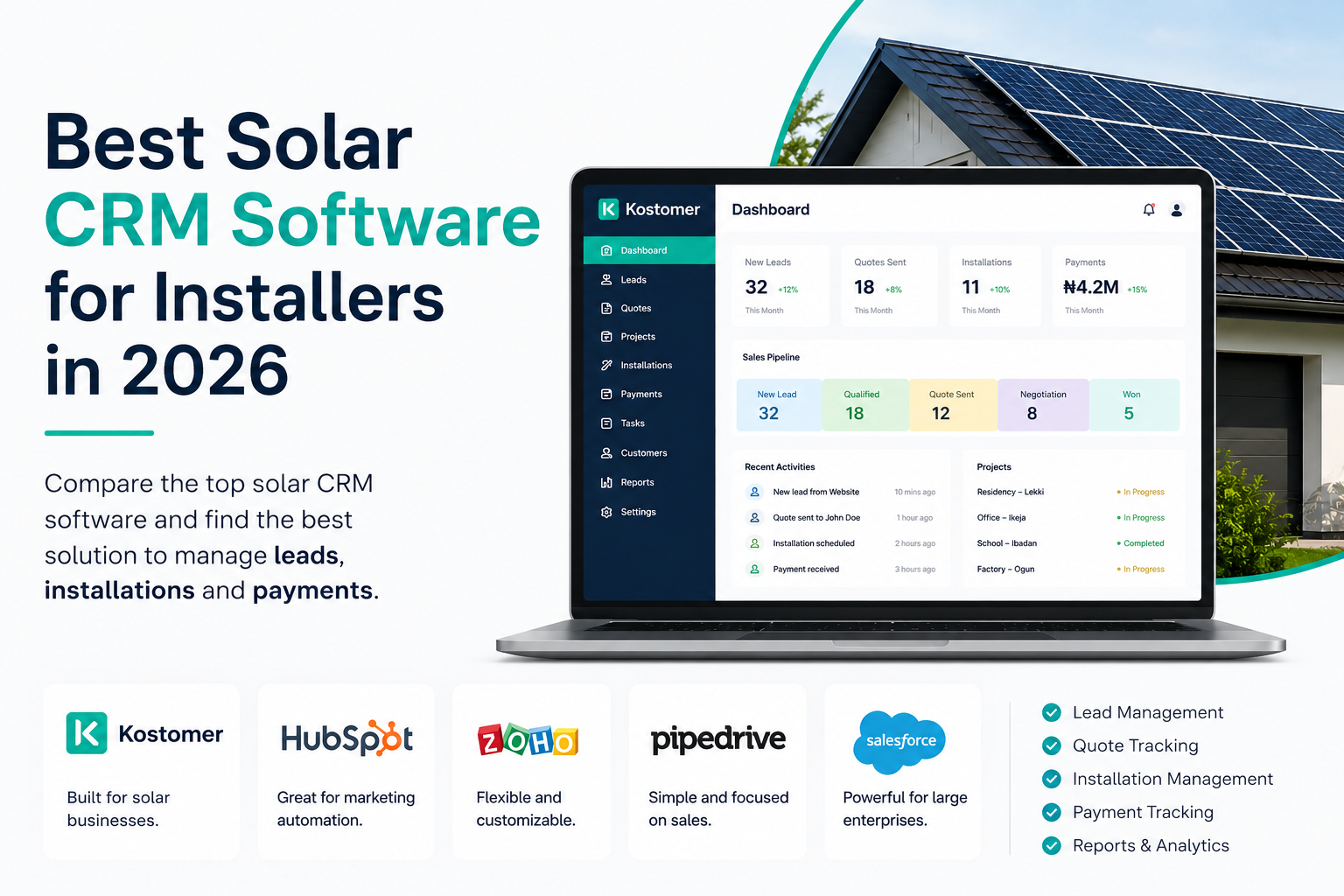
If you run a solar business, you already know the operational chaos that comes with growth.
Leads come in through WhatsApp. Quotes are created in Excel. Installation updates are shared in group chats. Payments are tracked manually.
It works for a while.
Then leads start slipping through the cracks, follow-ups are missed, and your team loses visibility.
That’s why more solar companies are adopting solar CRM software.
What Is Solar CRM Software?
A solar CRM is software designed to help solar companies manage the full customer journey:
-
Lead capture
-
Site inspections
-
Quotations
-
Installations
-
Payments
-
Follow-ups
Instead of using multiple disconnected tools, everything is managed in one place.
What to Look for in a Solar CRM
The best solar CRM should help you:
-
Track every lead
-
Send quotes faster
-
Manage installation progress
-
Assign tasks to your team
-
Record payments
-
Monitor conversion rates
If the software doesn’t improve visibility and accountability, it won’t solve your core problem.
Best Solar CRM Software for Installers
1. Kostomer
Kostomer is built specifically for solar companies.
It helps you manage leads, quotations, installations, and payments in one system.
Best for: Solar businesses that want a simple, purpose-built solution.
Key strengths:
-
Solar-specific workflows
-
Lead and project tracking
-
Team collaboration
-
Easy to use
2. HubSpot CRM
A popular CRM with strong automation and reporting.
Best for: Larger teams with more complex marketing needs.
Downside: Can become expensive and overly complex.
3. Zoho CRM
A flexible and affordable CRM used by many SMBs.
Best for: Businesses that want customization.
Downside: Requires setup and training.
4.Pipedrive
A sales-focused CRM with a clean pipeline interface.
Best for: Teams focused on lead conversion.
Downside: Limited project management features.
5. Salesforce
The most powerful CRM in the market.
Best for: Large enterprises.
Downside: Expensive and resource-intensive.
Why Generic CRMs Fall Short for Solar Companies
Solar businesses have workflows that go beyond basic sales tracking.
You need to manage:
-
Site inspections
-
Technical quotations
-
Installation milestones
-
Payment collection
Generic CRMs can handle some of this, but often require significant customisation.
Purpose-built tools are easier to adopt and better aligned with your day-to-day operations.
Which Solar CRM Is Right for You?
Choose Kostomer if you want a CRM designed specifically for solar businesses.
Choose HubSpot or Zoho if you need a general CRM and have time to configure it.
Choose Salesforce if you run a large enterprise with a dedicated technical team.
The best solar CRM is the one your team actually uses.
If your leads are scattered across WhatsApp and Excel, you’re losing opportunities and slowing down your growth.
A solar CRM gives you the structure you need to close more deals and manage projects with confidence.
Try Kostomer
Kostomer helps solar companies track leads, manage installations, and collect payments in one place.
If you’re ready to replace operational chaos with a structured system, Kostomer is built for you.
Ready to grow your business?
Kostomer helps solar, real estate and retail businesses manage customers, payments, reminders and more — all in one place.
Start for free →